Signs
Story Before the Category

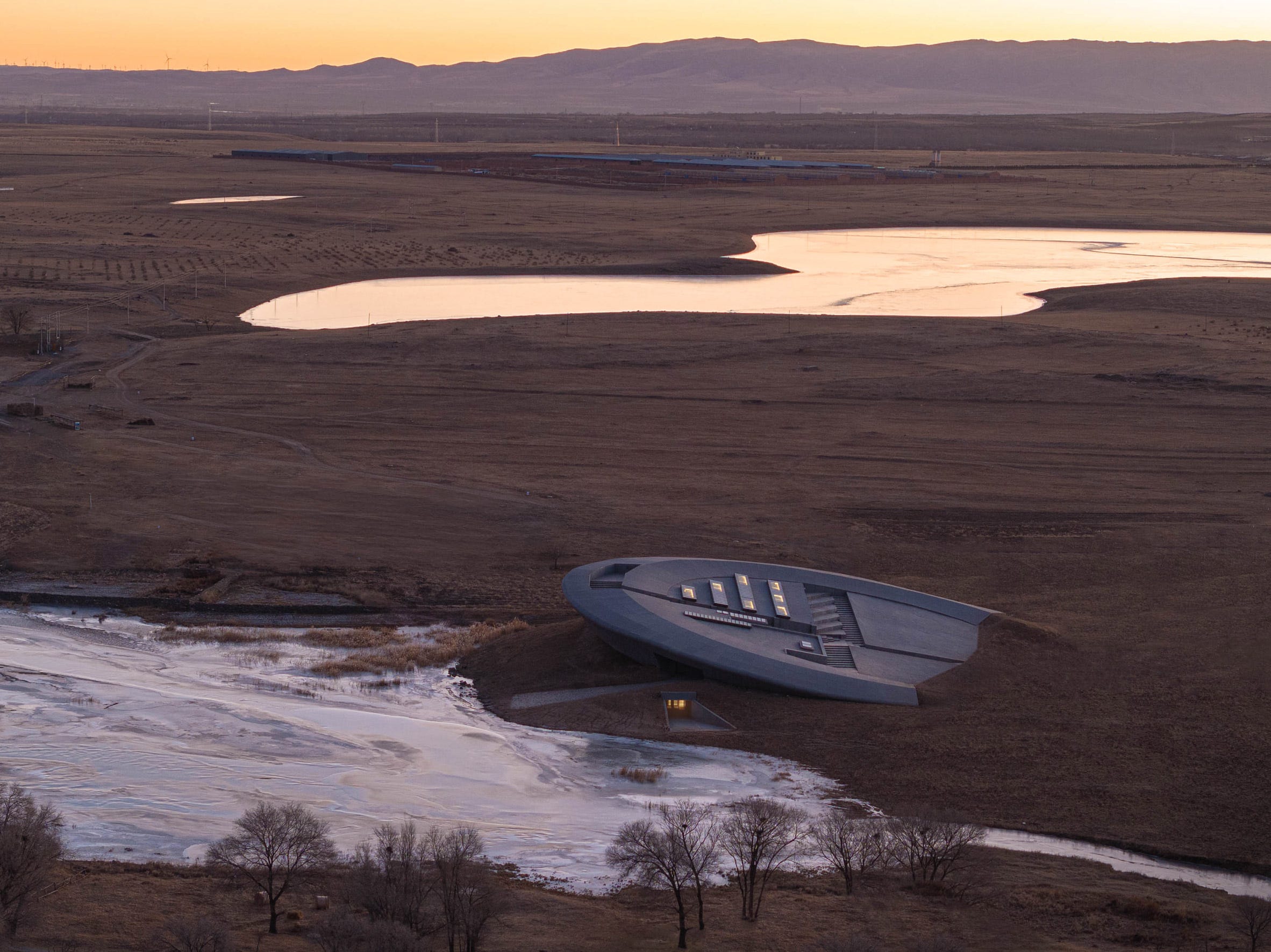
The sloping form of the building is submerged into the landscape on one end - Dezeen
The Horde and the Horizon
I read this beautiful piece this morning by Christian Yao
The grass here does not end. It adjusts.
From Laoli Lake outward in any direction, the Ulanqab steppe runs to a horizon that keeps retreating, and the eye, trained by cities and treelines, by walls and windows, keeps expecting the land to stop. It does not stop. It breathes. It was always breathing. What changed, around 1200 BC, was that something climbed onto the back of an animal that had been running this ground for ten thousand years, and the horizon became a direction rather than a limit.
That is the first thing to understand about what stands here now.
A Chinese architecture studio has placed two structures at the edge of this lake. The first is a gallery that enters the ground at one end and rises toward the sky at the other, its form half-buried, half-emergent, the whole mass suggesting an arrival that is also an excavation. The second stands on the opposite shore: a tower, vertical and watching, named for the nomads whose signal fires once crossed this exact air.
The architect says he refused the clichés. No yurts. No Genghis Khan. No superficial cultural tags. The refusal is genuine, and the architecture earns it. But refusal is not an escape. You can decline the costume while inheriting the skeleton. The gallery’s sloping roof folds into the steppe on one side, the way the Deer Stone burial mounds folded their horse remains into the same earth, hundreds of mounds arranged around standing stones across this landscape, some containing thousands of horses, all of them oriented between ground and sky. The Bronze Age builders were not being symbolic. They were being precise. The horse was the instrument by which this civilization first achieved a vertical relationship with horizontal space. Bury the horse at the base of the stone. Mark the axis. Signal the cosmos that something here understands altitude.
The saucer, three thousand years later, makes the same argument in different materials.
And the tower watches it from across the water.
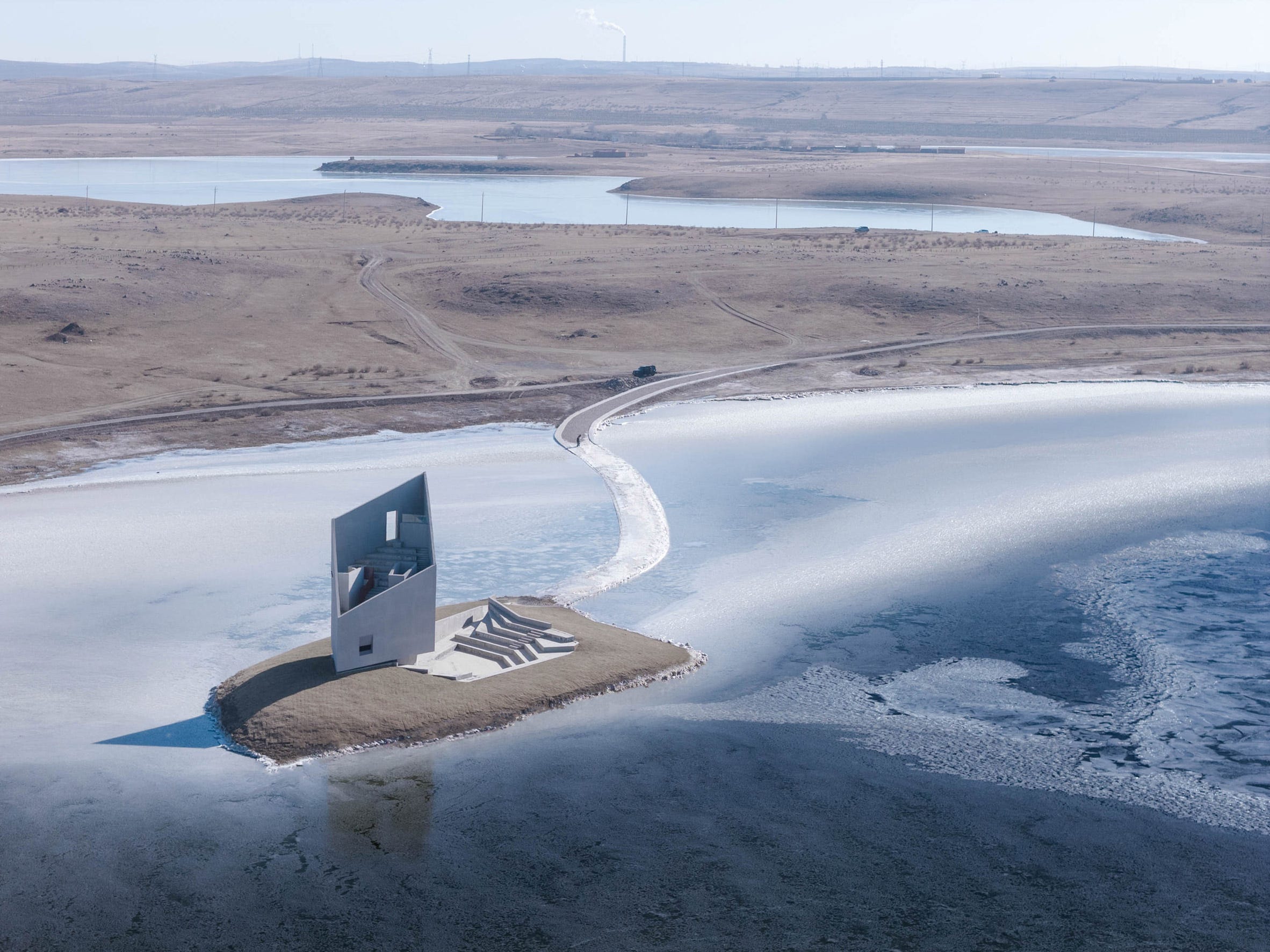
The Nomads' Beacon Tower is a viewing tower - Dezeen.
This is where beauty curdles into something older and more serious. The beacon tower on the Mongolian steppe was never a viewing platform. It was a nervous system. It was how the sedentary world learned, minutes before it was too late, that the horizon had begun to move. The Mongol cavalry at full gallop covered ground at speeds that compressed warning into prayer. The tower was not comfortable. The tower was the last honest moment before everything changed.
Genghis Khan did not conquer the known world on ideology. He conquered it on horses and on the steppe’s oldest truth: that mobility, applied at sufficient scale and sufficient speed, makes every fixed point a liability. Cities are fixed points. Walls are fixed points. The Great Wall is the longest fixed point in human history, and it failed because nothing fixed can hold against something that has made the horizon its native condition. The Mongol Empire at its height stretched from Korea to Poland. It remains the largest contiguous land empire ever assembled. It was assembled on horseback, by people who had been practicing on this ground for three thousand years before anyone thought to write it down.
The gallery sits in that ground now. Half-buried, reaching up, offering art exhibitions, brand events, and casual community gatherings. The tower watches from the eastern shore.
There is no malice in this. The architecture is serious, and the intention is honorable. But architecture on this particular ground carries weight that intention cannot fully govern. The steppe does not care what you meant. It has been the stage for the most consequential military technology in human history, and the memory is not metaphorical. It is geological. It is in the soil pressure under the gallery’s foundation. It is in the sightlines that the tower commands.
What Büro Ziyu Zhuang has built, without naming it, is a monument to the specific terror of open ground. The gallery buries itself because burial is the steppe’s oldest defense. The tower watches because watching is the steppe’s oldest survival mechanism. The lake between them holds the space that cavalry crossed in silence before anyone on the far shore could run.
The horses are gone. The grass remains. The horizon keeps retreating.
The eye keeps expecting the land to stop.
It does not stop.